
This is a reference you'll come back to. If you're about to make a first purchase, read it alongside how to buy Bitcoin; if you're comparing exchanges, it's the vocabulary behind our shortlist.
The four fee types, and who charges each
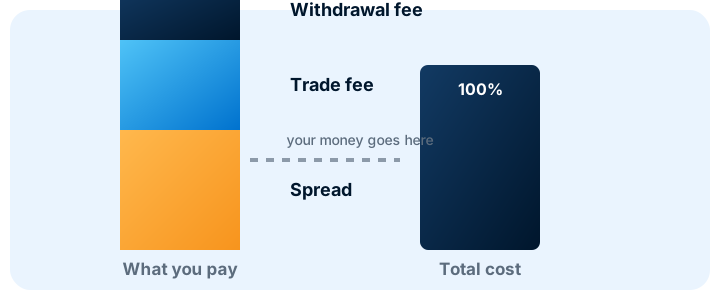
| Fee | Who charges it | When it appears | What drives its size |
|---|---|---|---|
| Spread / trade fee | The exchange or platform | Every buy or sell | Platform pricing; can be a % of the trade or a price spread |
| Deposit / payment-method fee | The exchange (or your bank/card network) | Funding the account | Method chosen: instant methods cost more, bank transfers often free but slower |
| Withdrawal fee | The exchange | When you move coins off the platform | Platform schedule; sometimes flat, sometimes per asset |
| Network fee | The blockchain (paid to validators/miners) | Any on-chain transfer | Network congestion; independent of the exchange |
The key distinction: the first three are set by the platform you use and can differ a lot between them. The fourth is set by the network itself — you pay it whether or not an exchange is involved, and no platform can make it free. When someone says "no fees," ask which of the four they mean.
Maker and taker fees: the two flavors of a trade fee
On order-book trading platforms, the trade fee usually splits into two rates:
- Maker fee — charged when your order adds liquidity to the book (you place a limit order that sits and waits to be filled). Typically the lower rate.
- Taker fee — charged when your order takes existing liquidity (you buy or sell immediately at the current price). Typically the higher rate.
For a beginner making a simple "buy now" order, you'll usually pay the taker rate, because you're taking the market. A concrete, verified example: Kraken's published fee schedule lists a base tier (from $0 of 30-day volume) at 0.40% maker / 0.80% taker, decreasing as your 30-day trading volume rises (official fee schedule, checked October 1, 2026). Note that separate tables apply to different Kraken products — check which one you'll actually use. We won't quote other platforms' specific numbers here, because they change; the point is to know which rate applies to the order you're placing.
How to compare platforms on the total, not one number
Here's a repeatable method. For the same purchase, add up all four costs on each platform:
- Start with the amount you intend to spend (say $100).
- Add the deposit fee for the funding method you'll actually use.
- Add the trade fee — use the taker rate for a simple buy, or the spread if the platform prices that way.
- Add the withdrawal fee if you plan to move the coins off the platform.
- Add the network fee for the on-chain transfer (this is the same on any platform for the same network).
Do this for each platform with its current rates, and compare the totals. Two platforms can look identical on the headline trade fee and differ meaningfully once you include the deposit and withdrawal costs. Our fee calculator does exactly this arithmetic — enter each platform's current numbers and it returns the total cost of a purchase.
Fees and the decision to hold
Fee structure matters most if you'll keep transacting. If your plan is one small purchase and then long-term holding, the differences between platforms are smaller in absolute terms — but the withdrawal and network fees to move the coins to your own wallet still apply, and the custody question still dominates. If your plan is recurring purchases, the recurring trade fee compounds, which is where the recurring-buy calculator and a transparent volume-tiered fee schedule (like Kraken's) start to matter a lot. Either way, the underlying risk — volatility, custody, and scams — is unaffected by fees. Read crypto risks before you let fee savings drive a bigger position.
Frequently asked questions
What's the difference between a spread and a fee?
A fee is an explicit charge shown on the order (e.g., "1.5%"). A spread is a built-in markup: the platform quotes you a slightly worse price than the live market and keeps the difference, so no separate line item appears. Both are real costs. If a platform doesn't show an explicit fee, check the price it's offering against the live market price — the gap is the cost.
Why does the network fee change so much?
Because it's a bid for priority on a shared network. When many people transact at once, fees rise to compete for space in the next block; when it's quiet, they fall. It's set by the network, not the exchange, so it's the one cost you can't reduce by choosing a different platform — only by timing or, for some assets, choosing a cheaper network.
Are "free" or "zero-fee" offers real?
Sometimes, with a catch. A "zero-fee" trade may be funded by a wider spread, a "free" deposit may be limited to slow methods, or a "no-fee" period may expire. Always work the total cost (all four fees) for the specific transaction you're making, rather than trusting a headline.
Do I pay fees when I just hold?
No. Holding crypto on a blockchain costs nothing per period — there's no storage fee for simply waiting. You pay fees when you transact: buy, sell, or move. (Some platforms charge inactivity or account fees on certain products; check the terms.) The network fee is paid on transfers, not on holding.
Where to go next
Put this to work: make a first purchase with the fees in view, compare exchanges on criteria, and use the fee calculator to total up the real cost of your own trade.