

If you're new to this, this page gives you the foundation: what cryptocurrency is, how it works at a high level, what people actually use it for, and — just as importantly — its real limitations. Nothing here is investment advice, and nothing here will tell you to buy anything.
Who this page is for
This guide is for adults with little or no crypto experience who want to understand the basics before making any decisions. You don't need math, coding, or finance background. If you already know what a blockchain is, you may prefer to jump to how blockchain works or crypto risks.
The three core ideas
1. It's digital, not physical
Cryptocurrency exists only as entries in a computer network. There are no coins, no bills, and — for most cryptocurrencies — no central institution that prints it. When you "hold" cryptocurrency, you hold a set of credentials (a private key) that lets you prove ownership and authorize transfers. That's why losing access to those credentials can mean losing the asset, and why the safety of your backup matters so much.
2. Cryptography does the securing
The name comes from the technology: cryptographic methods make it practically impossible to spend someone else's coins, to forge a transaction, or to alter history. You don't need to understand the mathematics to use it safely — but you should understand the consequence: security depends on you protecting your keys, not on a bank's fraud department.
3. The ledger is shared and public
Transactions are recorded on a public ledger that many independent computers (nodes) copy and verify. In Bitcoin's case, participants called miners compete to add new blocks of transactions, earning newly created Bitcoin and transaction fees for doing so. This is the mechanism that replaces a bank's role as the trusted record-keeper — with a tradeoff: the network is transparent and permanent, and corrections are far harder than in a bank account.
How it works, at a high level
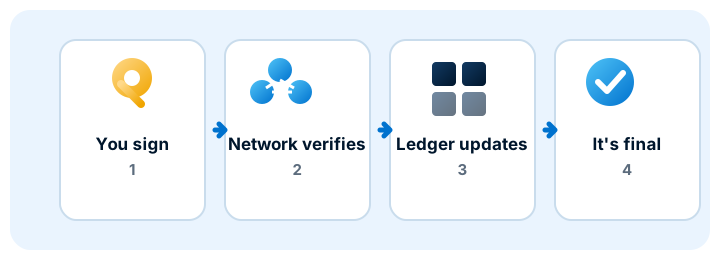
Strip away the jargon and a cryptocurrency transaction looks like this:
- You sign. You authorize a transfer with your private key. The signature proves you — and only you — approved it.
- Networks verify. Independent nodes check the signature and that the coins exist and haven't already been spent.
- The ledger updates. The transaction is added to the public ledger, typically grouped into a block with others.
- It's final. Once confirmed, the transaction is extremely difficult to reverse. There is no "chargeback" and no customer service line that can undo it.
That fourth step is the one beginners underestimate. A bank transfer you didn't make can be disputed. A cryptocurrency transfer you didn't make — or one you made to the wrong address — generally cannot be recovered. We cover how scams exploit this in avoiding crypto scams.
What people actually use it for
- Payments and transfers. Sending value directly to another person without an intermediary. Cross-border transfers are a common use case, though fees and volatility affect practicality.
- Store of value. Some people hold Bitcoin or other assets hoping their value rises over time. This is the speculative use — and the one with the most risk. Past price performance does not predict future results.
- Smart contracts and applications. Ethereum and similar platforms let code run on the ledger, powering applications from tokenized assets to decentralized finance. These are newer, less mature, and carry additional risks.
- Access to open financial tools. For people with limited access to traditional banking, crypto can offer a way to hold and move value — though it demands a level of technical care that traditional banking handles for you.
Notice what's absent: a promise that it's "safe," "free," or "guaranteed." None of those words apply. Cryptocurrency is a real technology with real uses and real risks, and your fit with it depends on your goals, your risk tolerance, and your willingness to handle security yourself.
Key limitations to understand up front
Volatility is the norm
Cryptocurrency prices can move dramatically in hours, days, or weeks. An asset can lose a large share of its value quickly, and recover — or not. If you need the money within a timeframe you can't name, volatility is a disqualifying feature, not a detail.
Irreversibility cuts both ways
The same finality that protects against double-spending means errors and fraud are rarely recoverable. Sending to a wrong address, or to a scammer, is typically the end of the story.
Regulation varies by country
Whether you can buy, hold, or use cryptocurrency — and how it's taxed — depends on where you live. The US treats most digital assets as property for tax purposes, which creates tax events you may not expect. We cover the US picture in crypto tax basics, and we label jurisdiction-specific information wherever it appears on this site.
Adoption is real but partial
More merchants, platforms, and institutions now accept or support cryptocurrency than a few years ago — but it is not yet a universal medium of exchange. Plan on converting to your local currency for everyday spending, and expect to pay fees to do so.
Is cryptocurrency the same as Bitcoin?
Not quite. Bitcoin is a specific cryptocurrency — the first, and still the most prominent. "Cryptocurrency" is the broader category, which also includes Ethereum, stablecoins, and thousands of others with different designs and risk profiles. When someone says "crypto," they may mean any of these. We explain Bitcoin and Ethereum on their own pages.
Frequently asked questions
Is cryptocurrency legal?
In most countries, including the United States, holding and buying cryptocurrency is legal, but the rules differ by jurisdiction and by use case. Some countries restrict or ban it. Check the rules that apply where you live before you start, and note that the rules change.
Is it anonymous?
No — it's more accurately pseudonymous. Transactions are public, and addresses can often be linked to real-world identities through exchange records and on-chain analysis. Privacy is not a reliable feature of mainstream cryptocurrencies, and several jurisdictions require identity verification (KYC) to use an exchange.
Can I lose my money?
Yes, in several ways: price falls, losing your private key or recovery phrase, sending to a wrong address, falling for a scam, or an exchange failing. Each of these has prevention strategies — that's what the safety and wallets sections of this site are for.
How is it different from regular money?
Regular money (fiat currency like the US dollar) is issued by a government and backed by institutions that can reverse errors and fraud. Cryptocurrency is issued and secured by software and a network of independent computers: no institution stands behind it, which means no institution can help you when things go wrong. The trade is between institutional protection and institutional control.
Where to go next
From here, the natural next steps are: what Bitcoin actually is, how the shared ledger works, and — before any purchase — the full risk picture. When you're ready to act, how to buy Bitcoin walks through a first purchase with the risks in view.